L’APERITIVO: IMAGINATION
Text by Vincent Moustache with AI assistance for research, proofreading, and translation. Illustrations by Vincent Moustache.

PLAYLIST "L’APERITIVO” LINK
Dear Croissant,
This is the aperitif for this new article series: Imaginary. With our heavy, constant use of screens as well as the use of AI (like this very article), we are being stripped of something as basic, necessary, and easy as the imagination. The foundational inspiration for these upcoming articles is imagination—not so much to help us create, but to help us find who we are, what path we are taking, and how we perceive our environment. I started researching the topic with AI's help and realized it made no sense to rewrite its words. I am leaving this new article format as an imaginary conversation with an AI. Let's see what you think of it. Is this a good use of AI?
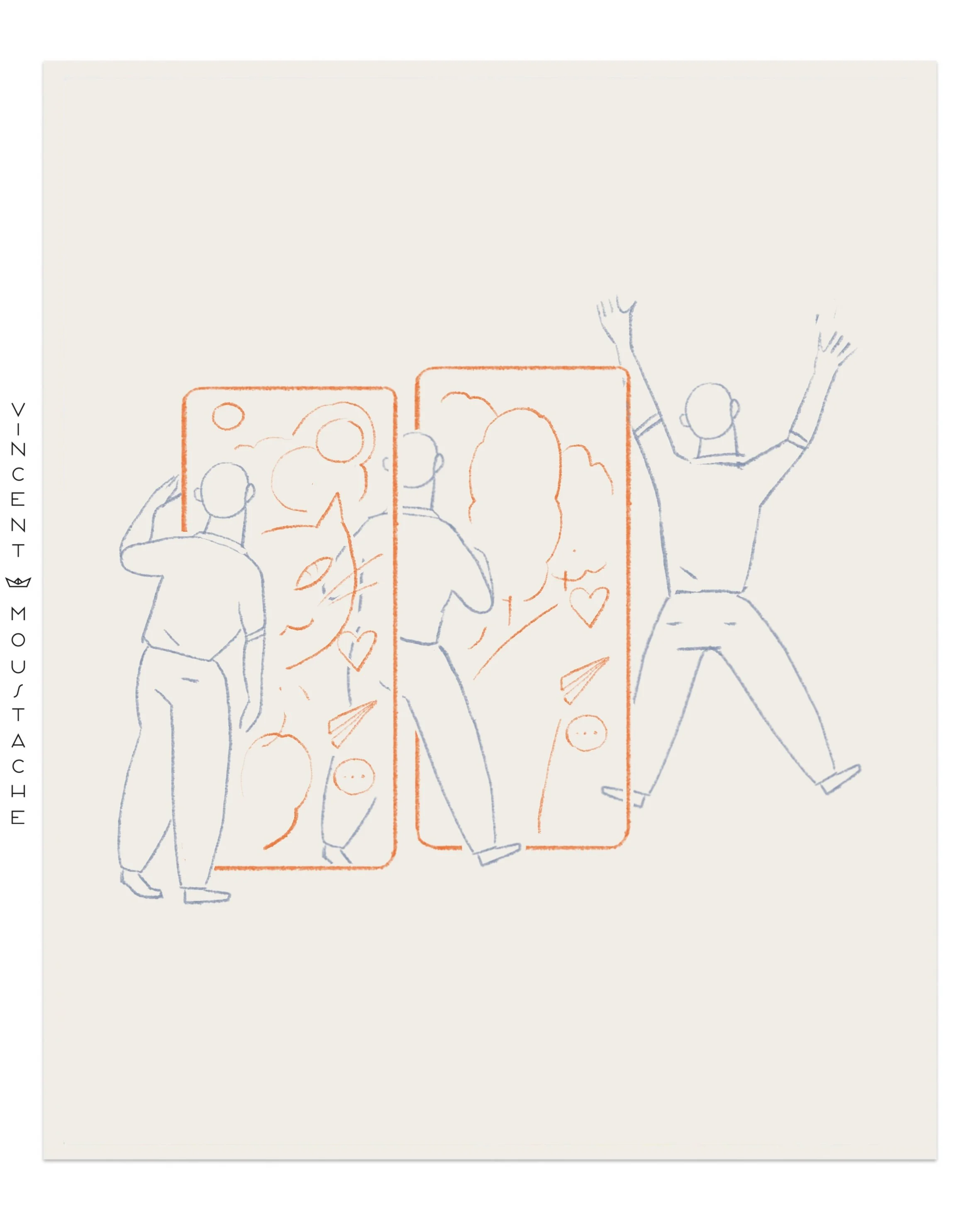
VINCENT: Search for articles on the current lack of imagination in children and adults linked to social media and screen use.
AI:
Recommended Articles and Studies
1. Screen Time and the Brain — Harvard Medical School
* Focus: Discusses how constant digital stimulation deprives developing brains of "mind-wandering" time. Dr. Michael Rich highlights that "Boredom is the space in which creativity and imagination happen."
2. How screen time affects toddlers: 'We’re losing a big part of being human' — The Guardian
* Focus: Features observations from educators noticing how young children default to recreating screens and devices during playtime rather than inventing original scenarios or solving physical puzzles.
3. Attention, Media Use, and Children — Children and Screens
* Focus: Details how passive video watching requires far less visualization and cognitive effort compared to reading or listening to stories, leading to less engagement of executive function and natural imagination.
4. What Does Too Much Screen Time Do to Children's Brains? — NewYork-Presbyterian
* Focus: Explores how excessive screen exposure leads to a form of "tunnel vision," restricting the rich real-world experiences children need to build spatial awareness, problem-solving, and play.The consensus among neuroscientists and psychologists is that constant consumption of hyper-stimulating digital content directly replaces time spent on boredom and unstructured play—which are precisely the two engines that ignite imagination in both children and adults.
In children, passive screen stimulation replaces the mental effort of visualizing stories, whereas in adults, endless scrolling fragments the deep attention span required to generate original creative ideas.
When the mind receives visual and auditory stimuli that have already been "pre-chewed" by algorithms, the brain has neither the need nor the space to create its own mental images. By eliminating boredom, we also eliminate the biological need to imagine.
What is unstructured play?
Unstructured play (also known as free play) is play that has no fixed rules, no predetermined goal, and no adult direction. It is play driven 100% by the child's curiosity and imagination.
Unlike playing a regulated soccer match or following instructions from a LEGO kit, in unstructured play the child decides what to do, how to do it, and when to stop.
How is it different?
Structured Play:
* Has external rules: Sports, board games, video games.
* A clear objective: Winning the match, completing the level, building the model.
* Directed or guided: A coach, teacher, or step-by-step instruction.
Unstructured Play:
* Creates its own rules: Inventing an imaginary world with action figures.
* The process is the goal: Exploring cardboard boxes, gathering sticks and mud.
* Child-led: Adults only supervise from a distance.
Why is it essential for the imagination and the brain?
1. Forces creation from scratch: With no screen or manual telling them what to do, the brain activates executive function and imagination to invent stories, characters, and settings.
2. Develops problem-solving: If an improvised block tower falls over, or if two children want to use the same branch as a sword, they have to negotiate and test solutions themselves.
3. Fosters tolerance for boredom: It is a child's natural tool for transforming "I have nothing to do" moments into active exploration.
A classic example: Giving a child an expensive electronic toy and watching them end up playing for hours with the cardboard box it came in. The box can be a rocket ship, a cave, or a kitchen; the electronic toy can only do one thing.
Explain the benefits of boredom for the brain and why it is so necessary to stimulate the creative mind.
For decades, we have viewed boredom as a negative emotion that must be eliminated immediately—and smartphones became the perfect "antidote." However, to neuroscience, boredom is not a useless void, but a crucial biological state for the mind.
When you are doing nothing, your brain enters a completely different and fascinating mode of operation.
1. The Brain in "Rest Mode": The Default Mode Network
When you stop paying attention to the outside world (no screens, no tasks, no stimuli), the brain does not shut down. On the contrary: it activates a massive neural circuit called the Default Mode Network (DMN).
This network links brain areas that do not normally communicate when you are focused on a task. While you are bored, the DMN is responsible for:
* Connecting distant dots: Retrieving distant memories, recent experiences, and isolated facts to cross-reference them. This is where sudden ideas or "Eureka!" moments are born.
* Processing identity: It is the space where you consolidate who you are, process lingering emotions, and develop self-awareness.
* Simulating the future: Your mind travels through time, rehearses hypothetical scenarios, and solves complex problems in the background.
2. The 3 Great Benefits of Boredom for Creativity
* A. Triggers "Divergent Thinking": When the environment becomes monotonous or boring, the brain feels a slight discomfort and seeks stimulation. If you don't hand it a phone to calm that feeling, the brain is forced to generate its own stimulation from within. It starts asking weird questions, imagining stories, or looking for alternative uses for everyday objects.
* B. Idea Incubation Occurs: You've surely noticed that your best ideas come to you in the shower, walking without music, or right before falling asleep. This happens because the conscious mind lets go of control. By being bored, you allow your subconscious to work on problems without the pressure of finding an immediate answer.
* C. Restores Deep Attention: Being constantly exposed to notifications and short videos exhausts concentration capacity. Boredom acts as a cognitive "reset": it clears mental fatigue and prepares the brain to focus with greater intensity afterward.
The modern paradox: By completely eliminating boredom with screens, we are eliminating the natural catalyst that drives us to create. If you never let your mind get bored, you never give it the chance to look within itself.
Explain the word imagination and its etymological origin.
Etymologically, imagination is the "action and effect of creating or reproducing internal images." It was born from the notion of copying or imitating external reality within the mind, later evolving into the capacity to create entirely new worlds.
The word imagination describes the mental capacity to represent images of real or non-existent objects in the mind, as well as the faculty of conceiving new ideas or projects.
Its etymological origin comes directly from Latin and is closely tied to the act of imitating or reflecting reality.
Step-by-Step Etymological Origin
1. From the Latin imaginatio: The word comes into English and Spanish from the Latin noun imaginatio (imaginationis), which meant "the faculty of forming mental images" or "the image created by the mind."
2. The verb imaginari: In turn, imaginatio derives from the verb imaginari (to imagine, devise, represent in the mind).
3. The root imago: Both the verb and noun are born from the Latin word imago (imaginis), meaning "image," "portrait," "representation," or "copy." In Ancient Rome, imagines were, for example, the wax masks or busts replicating the faces of ancestors.
4. Indo-European Root:aim- / im- Going back even further, imago comes from the Proto-Indo-European root aim- or im-, meaning "to imitate" or "to copy." Other words derived from this same root include:
* Imitate (from imitari)
* Image (from imago)
* Emulate (from aemulus)
5. The suffix -tion: Comes from the Latin suffix -tio (-tionis), used to form nouns expressing "action and effect."
THE APERITIVO IS SERVED:
Spritz, Negroni, Americano, Negroni Sbagliato, Crodino, or Sanbitter.
FACCIAMO UN APERITIVO?
JOB HUNTING
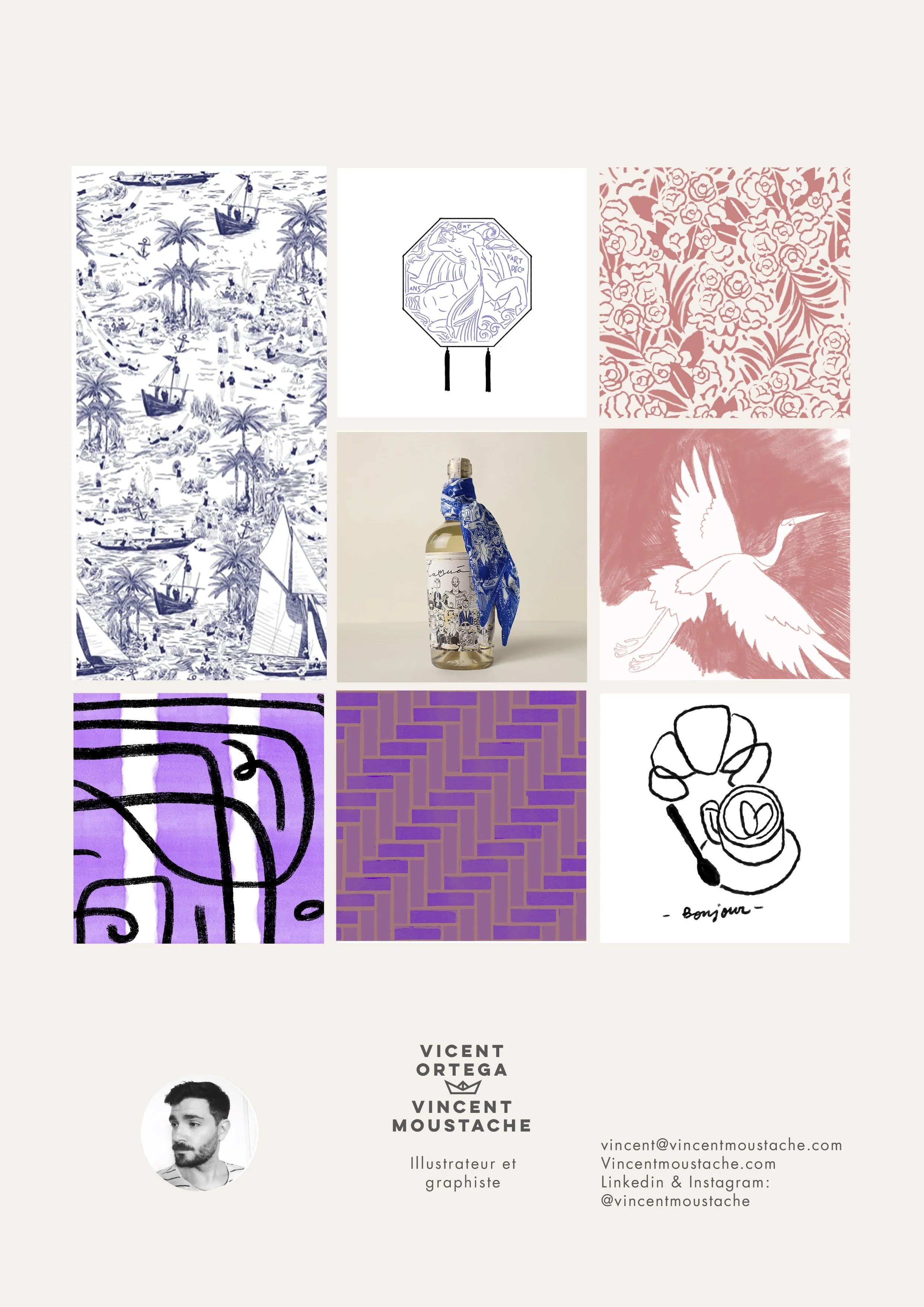
I am looking for a permanent position IN Paris (CDD or CDI) to bring some stability to this season. Here you can take a look at my CV and a summary of my portfolio.
À tout à l'heure sur Instagram !